Most gates in a quantum circuit aren’t doing quantum mechanics — they’re doing bookkeeping.
Paying for fault-tolerant qubits to unpack raw lookup tables and run temporary scratchpad math backward is like renting a particle accelerator to unzip a spreadsheet.
Most conversations about quantum computing focus on hardware: building more physical qubits, lowering error rates, and keeping fragile states alive for a few milliseconds longer. Hardware progress is essential. Yet open up the actual quantum programs designed to solve real scientific problems, and an uncomfortable truth jumps out: the overwhelming majority of gates are not doing “quantum magic” at all. They are shuffling uncompressed classical tables, carrying arithmetic bits that downstream steps barely notice, and painstakingly reversing scratch calculations just to leave temporary qubits clean.
Over the past weeks, while competing on Google Quantum AI’s Verifiable Quantum Circuit Compilation (VQCC) benchmark and building AncillaQ, we watched three flagship quantum workloads shrink by 13.5×, 34.3×, and 80.1× in verified fault-tolerant cost (a 33.32× geometric-mean speedup as of our latest verified submission, building on the 33.18× milestone pictured below). The biggest breakthroughs did not come from staring at five gates in isolation and swapping two of them. They came from rethinking what crosses the boundary between classical computers and quantum circuits, and from cutting the time needed to test a structural idea down to 23 microseconds.
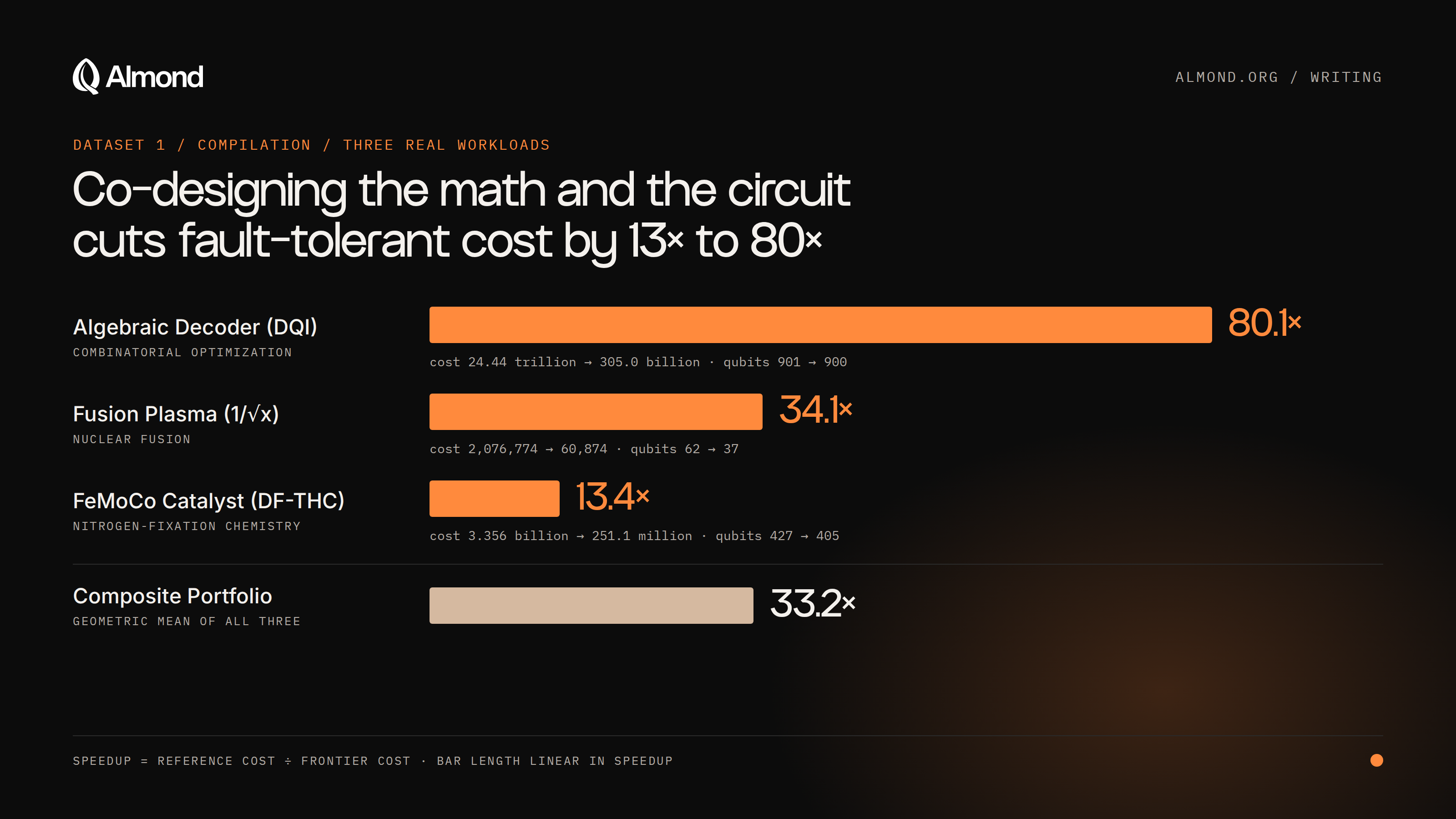
VIEW BENCHMARK NUMBERS AS A TABLE
| Workload | Domain | Reference Cost | Optimized Cost (v0.7 → Latest) | Qubits | Speedup |
|---|---|---|---|---|---|
| Algebraic Decoder (DQI) | Combinatorial optimization | 24.44 trillion | 305.0B → 305.0B | 901 → 900 | 80.1× |
| Fusion Plasma (1/√x) | Nuclear fusion modeling | 2,076,774 | 60,874 → 60,581 | 62 → 37 | 34.3× |
| FeMoCo Catalyst (DF-THC) | Nitrogen-fixation chemistry | 3.356 billion | 251.1M → 249.1M | 427 → 405 | 13.5× |
| Composite Portfolio | Geometric mean of all three | 1.00× | 33.18× → 33.32× | — | 33.32× |
Two rules of thumb for fault-tolerant circuit pricing
If you are relatively new to fault-tolerant quantum computing, you only need two rules to understand why circuits get expensive:
- Not all operations cost the same. Simple bit flips and XORs (
CXgates) are comparatively cheap in error-corrected hardware. Nonlinear logic gates like Toffoli (CCX/CCZ) (quantum AND gates) and arbitrary-angle rotations require expensive “magic state” distillation factories. Cutting Toffoli gates directly shrinks both runtime and physical hardware footprint. - You cannot just hit Delete on temporary memory. On a classical CPU, a function discards local variables when it returns. In a quantum circuit, discarding a scratch qubit that remains entangled with your register destroys quantum interference. By default, you have to run every intermediate computation backward (“uncomputation”) to reset temporary qubits back to
|0⟩, doubling the gate bill.
Those two constraints govern all three benchmark families:
- Nuclear Fusion Modeling (
1/sqrt(x)): Computing inverse square roots in superposition across 3,133,452 valid plasma states on just 37 qubits. - Nitrogen-Fixation Chemistry (FeMoCo): Simulating the iron-molybdenum cofactor that bacteria use to fix nitrogen at room temperature, streaming 75 batches of rotation angles through double-factorized / tensor-hypercontracted (DF-THC) quantum lookup loaders.
- Decoded Quantum Interferometry (DQI): Solving hard combinatorial optimization problems by running an algebraic error-correcting decoder coherently across 900 qubits and tens of millions of operations.
Compress the representation before you compile a single gate.
When a classical compiler optimizes C++ or Rust, the input specification is usually sacred. When you build a hybrid classical-quantum algorithm, classical preprocessing is virtually free, while every quantum AND gate is precious.
Take the FeMoCo chemistry circuit. At a high level, the quantum walk iterates over 1,219 molecular terms and loads 75 rotation angles at each address. Early versions stored 10-bit fixed-precision angle tables and paid 11,400 Toffoli gates per loader pass just to stream numbers into registers.
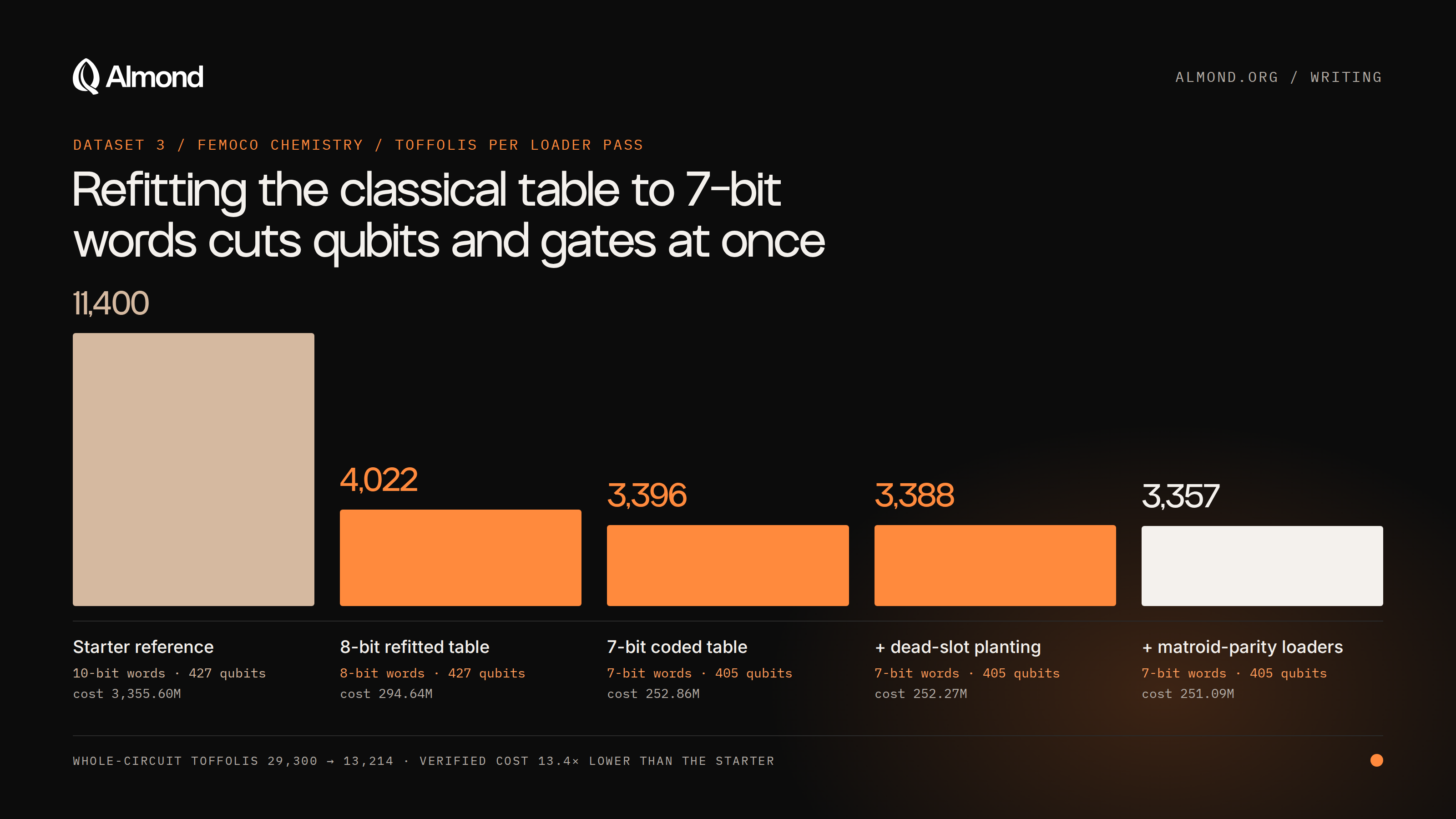
VIEW FEMOCO LOADER PROGRESSION AS A TABLE
| Stage | Precision | Qubits | Loader Toffolis / Pass | Verified Circuit Cost |
|---|---|---|---|---|
| Starter reference | 10-bit words | 427 | 11,400 | 3,355.60M |
| 8-bit refitted table | 8-bit words | 427 | 4,022 | 294.64M |
| 7-bit coded table | 7-bit words | 405 | 3,396 | 252.86M |
| + dead-slot planting | 7-bit words | 405 | 3,388 | 252.27M |
| + matroid-parity loaders | 7-bit words | 405 | 3,357 | 251.09M |
Treating the classical chemistry table and the quantum loader circuit as a single joint optimization problem unlocks three compounding wins:
- Width & Error-Boundary Co-Fitting: Instead of freezing the chemistry factorization first and rounding angles later, slide the continuous classical weights along the exact nullspace of the error constraint (
BoundarySliderandGramTensorWeightSolver) so 7-bit words still meet chemical accuracy (20 milli-Hartree) while shaving 22 qubits off peak width. - Encoding Transitions, Not Raw Values: Moving from batch
k - 1to batchk, the circuit only needs the bitwise XOR transition between consecutive batches. Five low-address parity carriers cancel across directions, and unused “dead” slots in the Givens rotation tree become free algebraic variables (DeadSlotPlanter) that simplify the Boolean lookup polynomial before synthesis begins. - Shared Nonlinear Products via Linear Matroid Parity: Pairing quadratic terms over finite fields (
lovasz_matroid_parity_rankandLinearMatroidParityPlanner) extracts free affineCXparity bits and shares nonlinear ANDs across output lanes, dropping the 15-loader pass to 3,357 Toffolis.
The cheapest quantum gate is the one your classical preprocessor made unnecessary.
Borrow idle wires and measure instead of recomputing.
Now look at the 37-qubit inverse square root circuit for nuclear fusion modeling. Squeezing a fixed-point Newton / piecewise-polynomial pipeline from 62 qubits down to 37 qubits creates severe “memory pressure”: at peak moments, every single qubit holds live data.
On a space-time cost model (Q × T, or Q² × T in DQI), freeing a single peak-width qubit can justify spending dozens of extra Toffolis inside the narrow window — and then recovering those Toffolis once the architecture adapts to the tighter footprint (a pattern we also documented across 31 elliptic-curve rewrites in Design Patterns Dispatch 2).
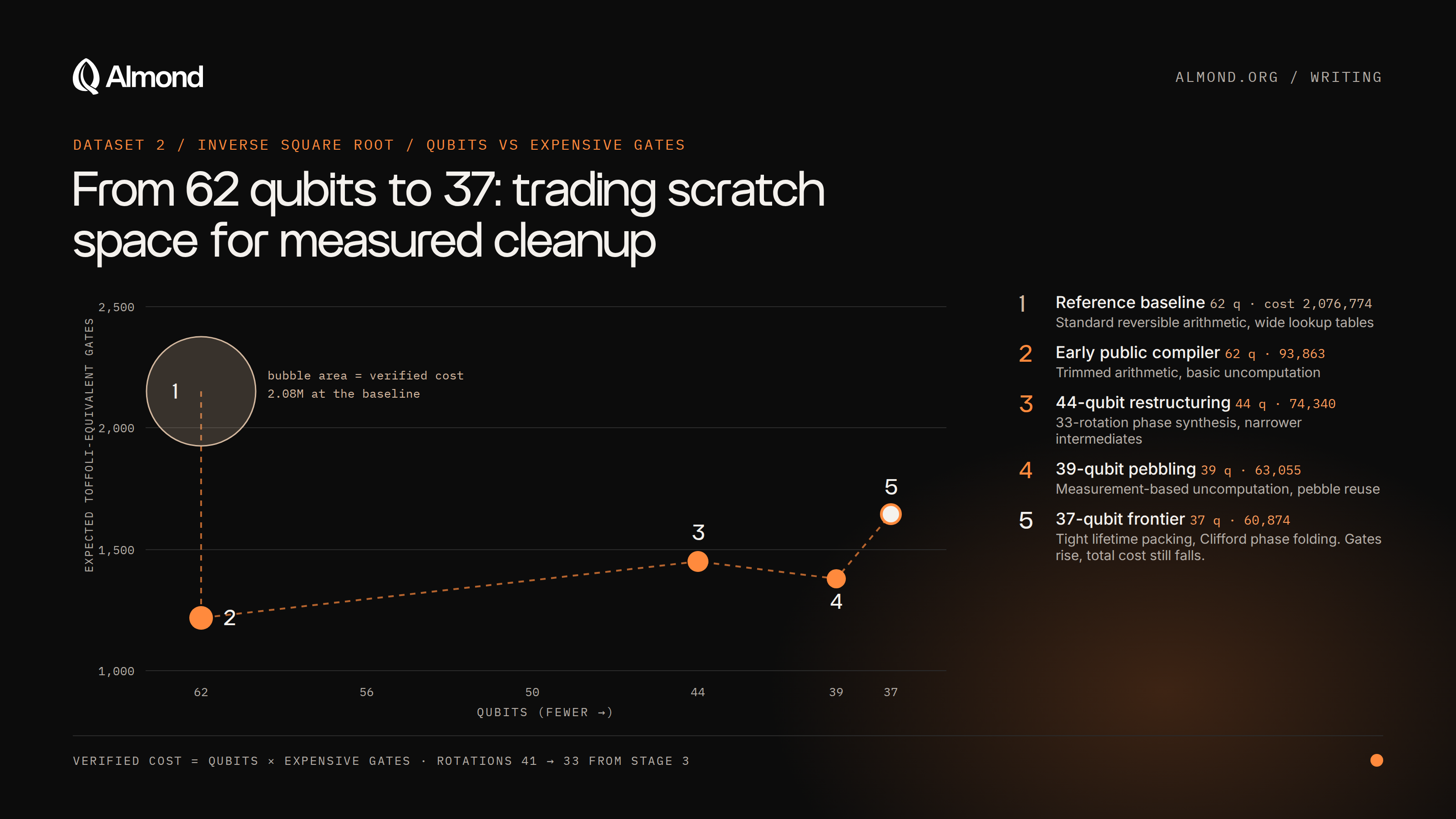
VIEW 1/√x WIDTH-VS-COST TRAJECTORY AS A TABLE
| Stage | Architecture | Qubits | Verified Cost |
|---|---|---|---|
| 1 | Reference baseline (standard reversible arithmetic, wide tables) | 62 | 2,076,774 |
| 2 | Early public compiler (trimmed arithmetic, basic uncomputation) | 62 | 93,863 |
| 3 | 44-qubit restructuring (33-rotation phase synthesis, narrower intermediates) | 44 | 74,340 |
| 4 | 39-qubit pebbling (measurement-based uncomputation, pebble reuse) | 39 | 63,055 |
| 5 | 37-qubit frontier (tight lifetime packing, Clifford phase folding) | 37 | 60,874 → 60,581 |
Two techniques consistently unlock scratch space when a quantum circuit looks completely full:
- Measurement-Based Uncomputation (MBU): Instead of running a 10-step
CCXAND tree backward to erase a scratch qubit, measure that qubit in the X basis (HMR), resetting it to a clean|0⟩immediately for zero Toffoli gates. Half the time, the measurement introduces a known-1sign phase on its input controls, which you repay cheaply with classically controlledCZ_IFphase kicks whenever those inputs are still live (demolish_and_piggybackandfit_multi_cut_phase). - Affine Wire Loans: Even when all 37 qubits hold live data, several wires often sit untouched across a 200-gate window, and one wire may temporarily equal the XOR of two others. XOR those neighbors into the idle wire to zero it out, borrow it as clean scratch space inside the window, erase your temporary work, and XOR the neighbors back at the end. Zero extra qubits, zero extra Toffolis (automated via
ancillaq wire-loans/find_affine_wire_loans).
Discovery speed is the real bottleneck — why we built a C++20 zero-copy engine.
Here is where theory hits engineering reality. Suppose an AI agent or researcher spots 200 places in a million-gate circuit where a reversible cleanup tree might be replaceable by measurement-based phase repair, or where truncating a carry bit might be compensated by nudging 33 downstream rotation angles via minimax linear programming.
Most structural candidates will fail a subtle invariant: a reverse-traversal check on unused addresses, a missing branch-dependent sign kickback, or a 0.0001% phase-tolerance violation on input #2,841,902 out of 3,133,452.
In a traditional text-based circuit workflow, testing a single candidate means serializing millions of gate lines to disk, parsing them back in, and re-simulating the entire circuit from gate 0. At 4 seconds per test, screening 5,000 structural hypotheses takes 5.5 hours. Discovery grinds to a halt.
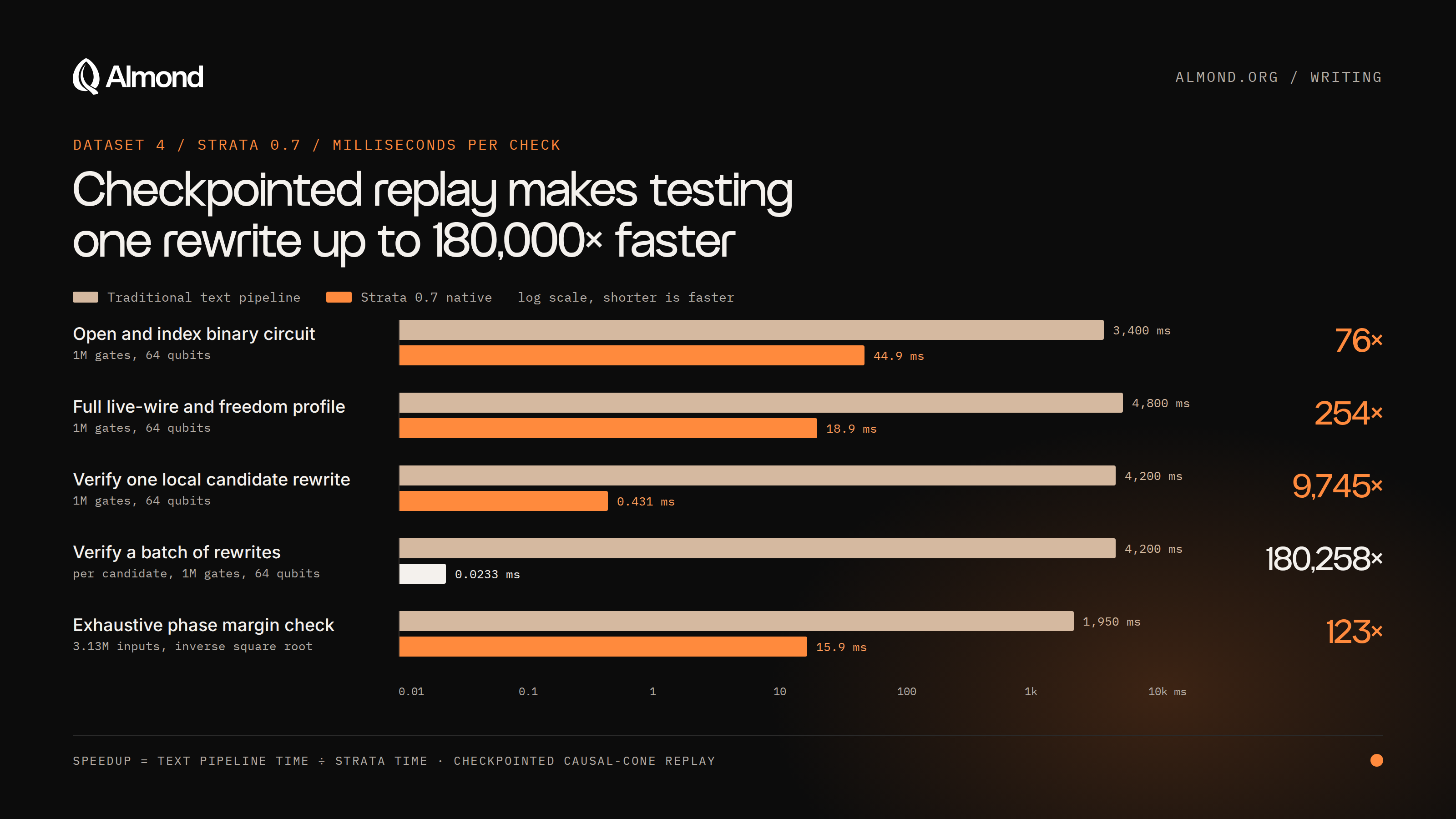
.kmb indexing and checkpointed 256-lane causal-cone replay cut batched rewrite screening by 180,258× — from 4.2 seconds down to 23.3 microseconds per candidate.VIEW NATIVE KERNEL LATENCY BENCHMARKS AS A TABLE
| Operation (1M gates, 64 qubits) | Traditional Text Pipeline | AncillaQ C++20 Native | Speedup |
|---|---|---|---|
Open and index binary .kmb circuit | 3,400 ms | 44.9 ms | 76× |
| Full live-wire & freedom profile | 4,800 ms | 18.9 ms | 254× |
| Verify one local candidate rewrite | 4,200 ms | 0.431 ms | 9,745× |
| Verify a batch of rewrites (per candidate) | 4,200 ms | 0.0233 ms (23 µs) | 180,258× |
| Exhaustive 3.13M-input phase-margin check | 1,950 ms | 15.9 ms | 123× |
AncillaQ removes that latency wall with three architectural primitives:
- Zero-Copy Hot Workspace (
KmbTape&Session): Binary.kmbcircuit tapes are memory-mapped directly into columnar C++20 arrays (44.9 ms for 1,000,000 gates, zero text parsing) and spliced directly in binary viacompose_kmb_fast. - Checkpointed 256-Lane Causal Cones (
BitSlicedSim): Instead of re-running gates 0 through 1,000,000 to test a 100-gate rewrite at position 650,000, AncillaQ jumps to a cached prefix snapshot, simulates 256 input trajectories in parallel inside CPU cache lines across opposing measurement-branch policies, and verifies or rejects a batch candidate in 23 microseconds. - 16-Millisecond Full-Domain Phase Checks (
eval_phase_margin_fast): Checking whether a new rotation fit satisfies error bounds across all 3,133,452 valid fusion inputs takes 15.9 ms — fast enough to sit directly inside an exact linear-programming loop.
From fast verification to mathematical kill-switches and macroscopic co-design.
Between previewing Strata 0.7 and shipping AncillaQ v1.0.0, we ran 14 focused research sprints across finite-field arithmetic, 900-qubit DQI decoding, and FeMoCo DF-THC chemistry. Many tempting ideas turned out to be dead ends — and turning those lessons into 5-second mathematical kill-switches turned out to be just as valuable as the optimizers themselves.
Here is what ships out of the box in AncillaQ v1.0.0:
- Fast
< 10sKill-Switches (ancillaq.gates):RotationPruningGateruns exact HiGHS minimaxL∞linear programs to certify which rotations can be dropped, snapped to Clifford, or snapped to T gates.ArithmeticTaperGateenforces a mandatoryndiff > 0check so silent algebraic no-ops are rejected immediately.ConditionBitTracerscans 70M+ op.kmbcircuits in under a second to separateOR-accumulators (Pr(0) = 2⁻ᵏ) fromXORparities (0.5) and immediate-HMRrepair blocks, while flagging dynamicCX_IF/SWAP_IFwire permutations.BatchSizeOptimizerpricestotal_items % Jzero-padding penalties against hardqubit_capwalls before you write a single generator line. - 500× Faster Tensor & Hamiltonian Co-Design (
ancillaq.gram):GramTensorWeightSolveruses the exact Gram identityG = (U @ U.T)²to optimize symmetric outer-product tensor weights inO(R³)instead ofO(R² N⁴).LowRankResidualTrackerperforms exact single-column coordinate descent without touching theO(N⁴)residual tensor.L1PreservingColumnPrunerprunes columns while preventing the catastrophic L1 /λblowup caused by naive SVD truncation, alongsideErrorDiffusionTreeEncoderand exactε = 0ActiveSetBoundarySnap. - Finite-Field, Symplectic & Pebble Algebra (
ancillaq.algebra+ C++20 OpenMP):CurveRankBoundbenchmarks finite-field multipliers against Chudnovsky-Chudnovsky and Cenk-Özbudak maximal-curve bounds (e.g.,GF(2⁶): 15,GF(2¹²): 42,GF(2²⁴): 99).CentroidDissectorcomputes theGF(2)centroid algebra to expose hidden extension fields or Wedderburn block splits before launching our OpenMP C++20flip_graph_gf2_fastKauers-Moosbauer search with plus-escapes.DicksonCCZReducercomputes exact minimumCCZcounts (rank(M + Mᵀ) / 2) gated by a mandatorycheck_span_safety()check against runtimeCX_IF/SWAP_IFwire permutations, andSpookyPebbleUndoAddersolves exact checkpoint DP schedules for reverse adders. - QROM Forensics & Basis Compression (
ancillaq.qrom):inspect_tableprofiles dead slots, pair-XOR parities, nonlinear ANF rank, and affine parity basesHₖ.B23PlaneAnnealerruns a bit-parallel transposed-uint64C++20 OpenMP annealer over invertibleGF(2)output transforms (with verified exact inverseL⁻¹), whileSelectiveChainUnlockersolves an exact 0/1 knapsack over tree-level curvature per Toffoli. - Disciplined Research Governance (
ancillaq.sprint):CostLedgerprices every family’s forward/reverse Toffolis, marginal qubit exchange rate (toffolis_per_qubit), and post-selection failure penalty.ExpensiveHMRProfilerranks immediate-HMRconditional repair blocks,SprintRunnerenforces 30-minute continuation gates and BLAS slow-iteration guardrails, andfork_poolprovides Linuxfork-safe multiprocessing on Python 3.14.
Pick the playbook that matches your circuit bottleneck.
Every module in AncillaQ v1.0 pairs with a focused, task-oriented playbook in the repository — complete with worked code snippets, exact mathematical conditions, and failure modes to watch for.
Run your first kill-switch and latency benchmark locally.
AncillaQ v1.0.0 builds its zero-dependency C++20 / OpenMP extension automatically with pip install on Python 3.11+ (with automatic non-OpenMP fallback if libgomp is absent). Follow the 5-Minute Quickstart or run:
# 1. Clone and install AncillaQ v1.0.0 with the C++20 native engine
git clone https://github.com/almond-lab/AncillaQ.git
cd AncillaQ
python3 -m venv .venv && .venv/bin/python -m pip install -e '.[test]'

# 2. Benchmark zero-copy .kmb indexing and 256-lane causal cones
.venv/bin/ancillaq benchmark-latency --ops 100000 --qubits 48 --cones 16

# 3. Audit condition-bit probabilities (OR vs XOR vs HMR) and finite-field bounds
.venv/bin/ancillaq curve-bound --field-bits 12
.venv/bin/ancillaq condition-audit path/to/circuit.kmb --top 16
.venv/bin/ancillaq hmr-profile path/to/circuit.kmb --top 16
.venv/bin/ancillaq batch-sweep --total-items 1024 --base-qubits 380 --bit-width 12 --j-values 1,2,4,8,16 --qubit-cap 430
Put every researcher and agent inside a tight, verifiable co-design loop.
When testing a structural rewrite costs microseconds instead of minutes — and when bad directions get killed mathematically in five seconds — how you work with AI agents changes overnight. Instead of asking an agent to guess a lucky peephole rewrite in the dark, you put it inside a tight, verifiable co-design loop:
- Profile and kill-switch first: Measure where qubits, nonlinear rank, condition-bit probabilities, and error margins actually bind, and rule out dead ends in seconds.
- Co-fit across the boundary: Optimize classical tables, representations, algebraic bases, and truncation budgets jointly alongside the circuit schedule.
- Screen at microsecond latency, prove independently: Screen thousands of candidate patches per second in 256-lane causal cones, promoting only changes proven exact by independent verifiers.
Hardware teams are working relentlessly to deliver more fault-tolerant qubits and faster magic-state factories. Compiler co-design meets them from the other direction: making sure every single qubit and gate we ask hardware to run is carrying irreducible information.
If you want to go deeper into verified gate-level and width-saving primitives alongside AncillaQ’s macroscopic co-design playbooks, read our companion series: Design Patterns for Optimizing Quantum Circuits, Dispatch 1 (26 Toffoli-cutting rewrites with Lean 4 proofs) and Dispatch 2 (31 width-reduction rewrites from the race to 647 qubits).
.kmb / .kmx).